
Newsroom overview
A progressive, legacy Argentine news organization focused on politics and human rights
Buenos Aires, Argentina
1987
2018
15 million
10 percent
Overview
When Página/12 launched in 1987, four years after Argentina emerged from a military dictatorship, it presented itself as the newspaper of democracy and human rights. Hoping to offer a different perspective to readers, it included a mix of news, investigative journalism, opinion, and in-depth analysis – all with a fresh hint of irony, which became their signature.
But by 2016, Página/12 faced two existential challenges: that of making digital journalism profitable and a change of government that put it in a disadvantaged position for government advertising, a key revenue source for media in Argentina. (Each administration tends to favor the outlets they feel more comfortable with. When the conservative Macri government came to power in 2016, it put most of its advertising with other media.)
So when Página/12 redesigned its website in 2016, it also leaned into its slogan “The Other Look,” a nod to its status as an “opposition” newspaper. The new slogan was part of its effort to build stronger identification with readers seeking a place for critical coverage of the Macri administration.
Página/12 found its earliest members among those readers. This case study shows how they leveraged an intellectually engaged readership to cultivate an online community built on comments. Today they average 3,000 comments a week, and while they would not share their exact membership numbers, Chief Digital Officer Mariano Blejman confirms that membership contributes more revenue than any single digital advertising contract. In other words, “the membership program is the main digital advertiser.”
Why this is important
When Página/12 launched its new website, it chose not to implement a paywall because leaders didn’t want to limit access. That meant they had to figure out how to make membership valuable in other ways. They decided to focus on building a community worth paying to join.
News organizations are increasingly focused on building communities, but they often do so off-platform, in places like Facebook Groups and Slack. That’s risky, because companies can change the rules at any point.
Building community on site, as Página/12 has, gives news organizations a more complete picture of their loyal audience members because they can see connections between reading and commenting behavior, as well as other factors such as newsletter subscriptions. It also reduces the risk that an algorithm change could sever their relationship.
But a membership program can only thrive when a news organization gets to know its members well enough to offer desirable member benefits, and a community can only develop when you invest in it. Página/12 did both.
What they did
Before launching membership, Página/12 surveyed audience members, asking questions such as how often they visited the website, whether they read the print edition, and whether they would be willing to financially support Página/12 to help ensure its economic and editorial independence. Seventy-three percent of the surveyed members said “Yes” to the question about financial support.
Asked what kind of benefits they would pay for, members chose options such as discounts to cultural and educational events, exclusive audiovisual content, and the possibility to contribute to stories. Página/12 also learned that they typically had a high educational level, and that many of them were academics or had similar “intellectual” jobs.
So they decided to offer two benefits: a variety of cultural offerings such as talks with reporters and online classes, and membership to an online space where this intellectual audience could engage with each other and contribute their knowledge.
The opportunity to have their voice heard is at the core of the membership value proposition. When Página/12 launched the membership program with Coral’s tool to moderate and manage comments, they made commenting member-only and appealed to loyal readers to join to “defend” their voice in the Argentinian media ecosystem, according to Celeste González, the engagement editor.
To act on that, Página/12 offered members – who they call “partners” – the opportunity to exercise their voice on their platform. Comments are called “contributions” and likes are called “respects.”
But offering the ability to comment and creating a community are two different things. When Página/12 launched its membership program, there wasn’t a person focused on nurturing the community. That changed when González joined as engagement editor a year later.
Her first challenge was bringing some order to a disorganized program so that they could actually fulfill their promise to members. At that time, there was no regular delivery of newsletters, monthly talks with reporters, or someone systematically responding to comments either.
González quickly took a few key steps:
- For the first few months, she read and responded to every single comment. If they commented on typos, grammar mistakes or asked questions, they would get an answer from Página/12 thanking them.
- To spark conversation and identify opportunities for engagement, she flagged articles with a high number of comments to relevant reporters, encouraging them to respond.
- She wrote and published monthly profiles of members, inviting them to share how they became a Página/12 reader and their motivation for becoming a member. Her goal was to show who the people behind commenting pseudonyms were. To do that, she chose the ones who participated the most, aiming to offer a variety of profiles and maintaining a gender balance.
- She encouraged members to share their experience with different topics, which feeds the newspaper coverage of those issues.
The results
González undertook all the steps above because she didn’t just want comments from the same few members over and over. She wanted to have more people commenting, and she wanted them to feel a part of a real community. As the number of members has grown, so has the number of comments.
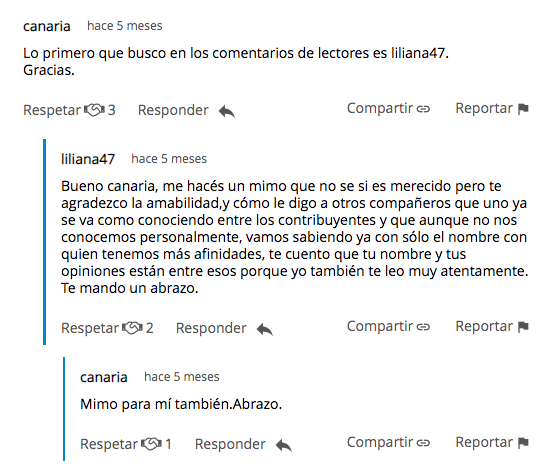
Today, members recognize each other in the comments. According to González, they already know what other people might comment or even anticipate if a member will like a given story or article. Here’s an example of one member (“canaria”) asking a member whose opinion they respect (“liliana47”) to share their thoughts.
Last December, members asked in the comments for an in-person gathering, so Página/12 organized a holiday party. Seeing those who had met in the comments section celebrating in person was a big success for González.
This effort to build an online community especially paid off when Buenos Aires went into lockdown at the outset of the coronavirus pandemic – one of the strictest lockdowns in the world at the time. While some news organizations scrambled to adapt to online community building, Página/12 had already been doing that for a couple of years.
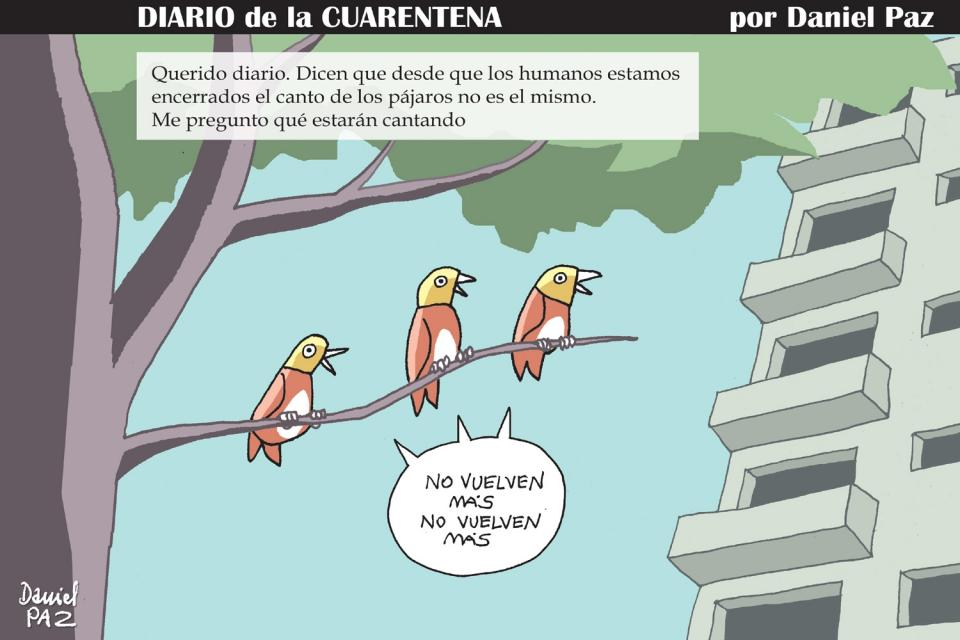
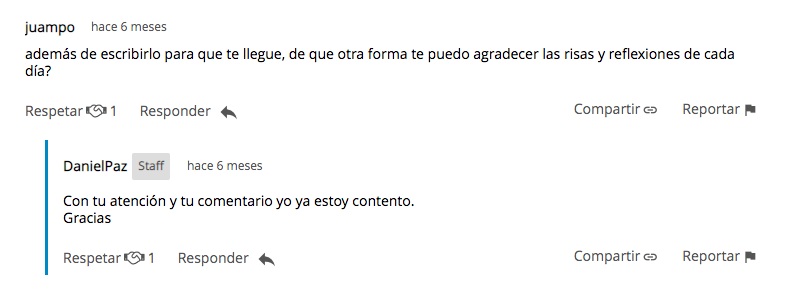
Daniel Paz, the newspaper’s illustrator, began publishing daily illustrations of life in lockdown. Members started commenting, so he started to reply. It’s become a daily routine – he uploads a new diary entry every day, and then begins a conversation with members about their lockdown experience.
The COVID-19 pandemic also allowed the organization to expand the ways it works with members. After reading a reader comment asking about how coronavirus spreads, a member offered to analyze for Página/12 how the virus spread in each country.
Some of that member’s colleagues joined him in that work. They already knew each other from the scientific community in Bariloche, in the southern region of Patagonia, and were used to science communication. Using WhatsApp and Google Docs, they put together a comparative analysis on how different countries responded to the crisis. The result was a collaborative article that ended up being published on Página/12 and received more than 130,000 unique visits. As González put it, “the mutual exchange is the axis of the membership program and what makes it different.”
González also encourages the staff to participate in these conversations, but, despite a few internal training sessions on engagement, she usually still has to initiate reporter participation in the comments.
What they learned
The right indicators are crucial. When Página/12 first started tracking commenting analytics, it did it in absolute numbers: the total number of contributions and respects, regardless of who was commenting on or reacting to other members’ posts. But González didn’t want to just grow the number of comments, she wanted to grow the number of people contributing comments. So she changed how she paid attention to commenting activity. Now she is tracking the number of active commenters in any given month, as well as the total number of comments, so she can assess whether comments and the number of participants leaving them are both growing. For example, in April 2020, they had 1,256 active commenters who left 25,487 comments.

One person can’t do it all. There’s only so much one engagement editor can do to create a vibrant online community. The rest of the newsroom needs to get involved, too. To encourage this, González pays attention to which articles are sparking conversations, and reaches out to the reporters directly asking them to join the conversation. Often, they don’t know how to get started, so she suggests some possible replies. She’s learned that the easiest comments for reporters to engage with are those that ask specific questions about the article.
Key takeaways and cautionary tales
Dedicated staff are essential for online community building to work. Even when a newsroom uses a tool like Coral that is designed for community management, it needs to know how to use it well. An engagement editor who identifies opportunities for conversations is an indispensable role. That person can not only feed the discussion, but share insights with the newsroom to encourage their participation.
The right technology is, too. For Página/12, which went from having an online version of the print edition to an in-platform community in four years, that has been a major challenge. Although it has the commenting section covered, other aspects of digital membership haven’t been resolved, such as having a landing page for members. “We’re still resolving a tech debt that in terms of UX means that Página/12 still isn’t providing the user experience that we would like to provide,” González said.
Old habits die hard. Members and reporters need help understanding this new way to interact. González has had to invest time not just in encouraging members to engage, but teaching reporters the most effective way to engage back and how to incorporate that into their workflow.
To build a community, you need to know who your community members are. Página/12’s members share an ideological affinity and many of them have an intellectual or academic background. They are motivated by opportunities to share that knowledge. So Página/12 developed a member benefit – the ability to offer comments – that meets their desire to engage intellectually with others. The more you understand about what your members value, the easier it is to develop a membership program that will resonate.
Other resources
- Coral, resource: How to Create Your Community
Disclosure: Membership Puzzle Project has provided support to Página/12 through the Membership in News Fund. Aldana Vales, the author of this case study, occasionally freelances for Página/12.