
Newsroom overview

Who They Are
The Bristol Cable is a member-owned cooperative news organization in Bristol, U.K.
Location
Bristol, U.K.
Founded
2014
Membership program launched
2014
Monthly unique visitors
50,000
Number of members
2,700
Percentage of revenue coming from membership
35%

The Bristol Cable is a British member-owned cooperative news organization. As owners, members are legal shareholders and therefore must be consulted when making certain strategic decisions that affect the organization. One such decision is what kind of advertising the Cable will accept.

Initially the Cable decided to address that with an “Ethical Advertising Charter” that included types of companies and organizations from whom it would accept advertising from. But that ended up being too restrictive, so in 2017 they worked with members to amend the charter, focusing instead on criteria for what kind of advertising the paper would accept and how it would be presented to ensure that it aligned with the Cable’s values. 

The revised Ethical Advertising Charter helped the Cable balance the need to include its members in the decision-making process with the need to make daily operational decisions in an efficient manner that also isn’t burdensome for members. This case study outlines the process of developing the charter and applying it to advertising decisions.

Why this is important

Like any news organization, the Bristol Cable wants to ensure diversified revenue streams to support and sustain its journalism – and with a dedicated local audience for its print newspaper, the Cable sees advertising as a necessary part of its revenue pie. 

But as a member-owned cooperative, the Cable must ensure that its member-owners have a voice in decision-making – and that includes ensuring that any advertising it accepts is in line with its values as an organization and supported by the majority of its members. 

Previously the Cable had a list of organizational types that member-owners had approved accepting advertising from, but the staff found that relying on a list was too limiting and prescriptive, while also not capturing all factors. 

The Ethical Advertising Charter was amended to instead lay out guidelines for making advertising decisions, which the Cable team can then apply to each individual decision.

Although few news organizations are owned by their members and therefore must invite them into decision-making, more newsrooms are choosing to invite members into decision-making. The Bristol Cable’s solution for balancing the need to make individual decisions quickly while still honoring its member-owners’ values is instructive for any newsroom. 

What they did

From the outset, The Bristol Cable recognized the importance of diversifying its revenue streams, which is why it decided to accept advertising. 

However, they put strong guidelines in place for advertising: advertisements only run in the Cable’s quarterly print newspaper, not online or on any digital platforms, and are limited to only five pages for every 40 that the Cable publishes. 

Today the majority of the Cable’s funding comes from grants, but about 35 percent of its revenue comes from membership and another 5 percent or so comes from advertising, according to Adam Cantwell-Corn, the Cable’s co-founder and coordinator.

As a mission-driven publisher, Cable wanted to ensure that the ads it accepted were in line with its editorial values. So at the Cable’s 2016 Annual General Meeting, the Cable’s member-owners voted to put in place a list of organizational categories that they found acceptable and from which the Cable would be able to take advertising. (The Annual General Meeting is a yearly gathering where member-owners elect a board of directors, approve a budget, and weigh in on key organizational decisions.)

But it quickly became apparent that the 2016 policy was too specific, and the list was not serving its purpose. 

So the Cable team brought the issue back to its owners at the Annual General Meeting in 2017, the following year. Together, they decided to draw up a principle-based advertising policy that the Cable staff could apply to individual advertising decisions as they arose. Cantwell-Corn said the message from members was clear: they trusted the operations team to apply those principles to decisions the way that members intended.

The result was the Ethical Advertising Charter, which publicly explained Cable’s policies toward advertising. The charter has three primary sections: editorial integrity, advertisements, and decision making. 

The editorial integrity section explains that all advertising will be clearly labeled and separated from editorial coverage. It notes that the Cable will “ensure that its editorial content is not influenced by advertisers.” 

The advertisements section of the charter details what kind of ads the Cable will accept. The charter states that the paper will seek to run advertisements that: 

  • “promote social and cultural events and activities that may be of interest to its general readership;
  • products and services that are of direct benefit to local citizens and the city’s economy and environment;
  • such other adverts as are considered to be in line with the Cable’s ethical stance especially those from independent local businesses and third sector organisations.” 

The decision-making section explains that all determinations about advertising are delegated to the Cable’s advertising team to make in line with the member-approved guidelines. 

The results

The Cable staff has found the charter easy to apply, even when tough decisions arise. 

In early 2020 Bristol Water, the city’s public water utility, reached out to the Cable about placing an ad. The Cable’s advertising coordinator flagged it for the leadership team because of “excessive executive pay, dubious tax practises and unacceptable price increases,” and they assessed the company against the Ethical Advertising Charter. 

The editorial staff pulled Bristol Water’s annual financial reports and tax filings. They thought that high rates of executive pay and repeated attempts to raise water prices violated the Cable’s cooperative values, and thus were in conflict with the charter. 

“We believed this would compromise us,” said Lucas Batt, the Cable’s membership coordinator. 

The staff felt comfortable making this decision without consulting members because they had the principles outlined in the charter to guide them. 

Then, in November 2020, Cantwell-Corn published a story about the utility’s attempts to repeatedly raise water prices in Bristol. 

Along with the story, the Cable explained to readers that they had rejected an ad from Bristol Water. The charter stipulates that when the advertising team decides not to proceed with an advertisement, it must provide an explanation to the advertiser and to the public “where appropriate.” 

The Cable also turned it into a membership appeal. 
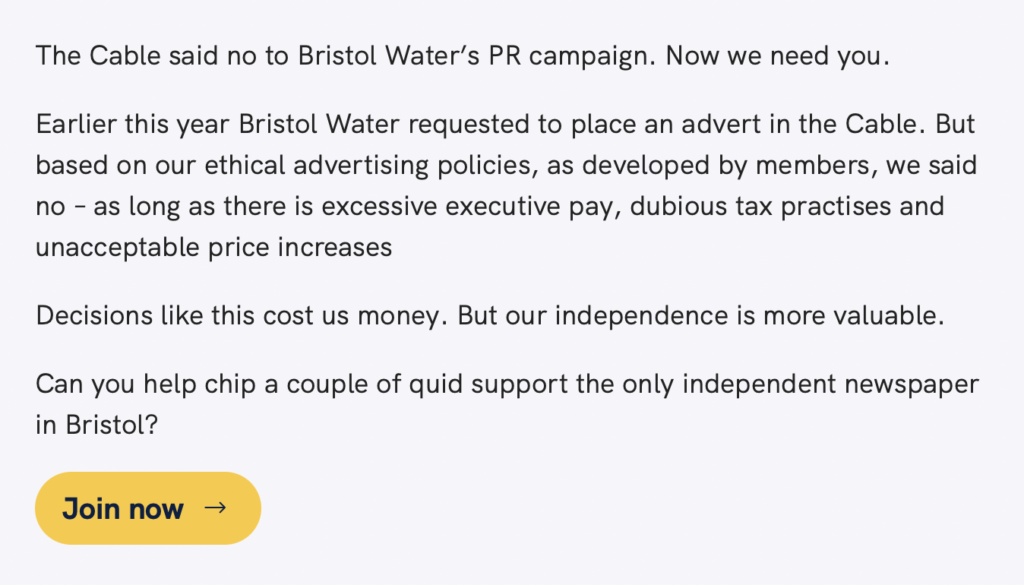
Cantwell-Corn said the appeal attracted “a number of people” to join, but he noted that it was “part of the overall sweep of communications that we’re doing that are trying to persuade people to convert members.”

The Cable has rarely had to invoke the charter since 2017. Cantwell-Corn attributed that to two key reasons: 

  1. The Ethical Advertising Charter is listed on the Cable’s website, so that helps filter out organizations who think they wouldn’t fit the bill. 
  2. There are lots of places where local organizations can advertise their goods or services — as all legacy news organizations know, it’s often cheaper and more effective to advertise via Facebook or Google where you can target specific audiences.

Cable members support the publication because they believe in what it stands for, and Cantwell-Corn said members were generally supportive of the decisions, such as the decision to take advertising that aligns with their values. 

 “We’re living in an imperfect world,” he said. “We have to have strong ethical principles, but we also make the compromises we need.” 

What they learned

Principles can be better than specifics. The 2016 Ethical Advertising Charter was just a list of organizational categories that the Cable was approved to accept advertising from, which didn’t do the Cable team much good when a company approached them that wasn’t on the list or was in a grey area. The revised charter instead outlines “principles and parameters” that can be applied to any company. This has given the document much broader applicability and removed the need to go back to members on the same issue repeatedly.  

The advertising charter can be a selling point. While the Ethical Advertising Charter does provide some limitations, including potential revenue opportunities, it also is a “mark of quality,” Cantwell-Corn said. And the Cable leans into mission alignment when they pitch advertisers.

The Cable has become a go-to for companies and organizations that are trying to present themselves as more ethical to their consumers, such as green energy suppliers, NGOs, and local businesses. 

“That means we can say to them as a value proposition to the advertisers that, within the boundaries we have set…, your advert will have prominence and will have quality pieces of editorial around it. The other adverts that are present also are validating the quality and the brand validity of your own company by being in The Cable,” Cantwell-Corn said. 

Key takeaways and cautionary notes

The core values you hold could limit existing revenue opportunities, but if you lean into them, they can also open up new ones. There’s a good chance there are companies and organizations out there who have similar values and want to ensure their advertising dollars go to like-minded organizations. By refocusing your pitch to advertisers on what you stand for and why it could be beneficial to align themselves with you, you might attract advertisers that a more transactional pitch might not have.

Establishing trust is not a one-time action. Inviting member-owners to co-write the Ethical Advertising Charter was a smart way to establish or strengthen trust in the Cable’s decision-making. But if the Cable hadn’t consistently applied the charter after it was approved, owners’ role in the drafting wouldn’t have made a difference. Each time the Cable properly applies the charter to an advertising decision, it is giving member-owners yet another reason to trust the Cable. 

Other resources 

Newsroom overview

Who They Are
WTF Just Happened Today is a newsletter, blog, and community chronicling the "daily shock and awe in national politics"
Location
Seattle, Washington
Founded
2017
Launched membership
2017
Percentage of revenue from membership
100 percent

When Matt Kiser launched WTF Just Happened Today (WTFJHT) in January 2017, it started as a side project to report on the first 100 days of Trump’s presidency. Early on in the site’s founding, Kiser was spending ~$500 per month (mostly on Mailchimp) to publish the newsletter and run the blog. 

About a month into running the site, Kiser decided to ask his audience for money to help offset out-of-pocket expenses. He knew he needed to raise about $4,000 per month to cover the first 100 days of his work, so he reached out over his email newsletter list to ask for donations. In just a few days, 415 people signed on to support the site. By mid-February, 540 people had signed on and Kiser was up to $3,100 per month in recurring reader support. 

That’s about when he decided to funnel that support into a membership program and quit his day-job to run WTFJHT full-time. That’s also when he realized he needed an actual budget. 

Why this is important

When it comes down to it, the costs and revenues of running a member-driven news site are what determines the longevity of the site. But figuring that out, especially in the beginning, can feel like guesswork. Kiser was only able to commit to WTFJHT once he raised enough money to feel secure enough to quit his day-job. 

Today, he has a more sophisticated sense of what he can expect each month in terms of costs and revenue (and has started to pay for freelancers and other staffing support), but in his early days, Kiser had to make strategic decisions each month based on his revenue projections. 

What they did

Three years after launching WTFJHT, Kiser has accrued a few more monthly costs – including his new, full-time salary, a budget for freelancers, and additional software and tools. Kiser is extremely transparent about the monthly costs associated with running this site. His method for managing his budget remains fairly straightforward. 

In order to be fully transparent with his readers and members, Kiser lists out all of his monthly costs on his website. See below for those costs, ranked from highest to lowest. In total and including other fluctuating costs month to month, this equals a little over $16,000 per month. 

Monthly costs:  

  • Kiser’s full-time salary:  $7,385 
  • Kiser’s risk adjustment for being a full-time contractor: $2,089, or 15% of total cost (quarterly taxes, healthcare, other unexpected costs)
  • Freelancers: $3,000
  • Podcast and Hosting: $2,000 (AWS S3 to host the daily podcast and cache the files with AWS CloudFront; and monthly stipend for podcast producer)
  • Mailchimp Email Service: at least $900 (with a 15% discount applied)
  • Other Tools: ~$320 (a GitHub subscription for hosting the code, YellowBrim for email efficiency, Cloudflare for various security and serving issues, Buffer for posting, Canva for quickly creating social images, and Zapier to automate boring tasks, among others): 
  • Hosting via Amazon S3, and CloudFlare to manage  DNS, SSL certificate, and handle caching: $125
  • NewsWhip Spike, a tool to source daily news (with a discount applied): $100
  • Subscriptions, to the New York Times, Washington Post, Wall Street Journal, Bloomberg, The Atlantic, and a few others: ~$100

WTFJHT is 100 percent supported by members – Kiser doesn’t take any advertising or sponsorship dollars, which is why when he lost 150 net supporters over the past year, it was cause for some alarm. Kiser sees this churn as a part of the natural life cycle of his members, but knew it meant that he would be losing about $900 a month in income. It was time to reach out to his members again and ask for their support. 

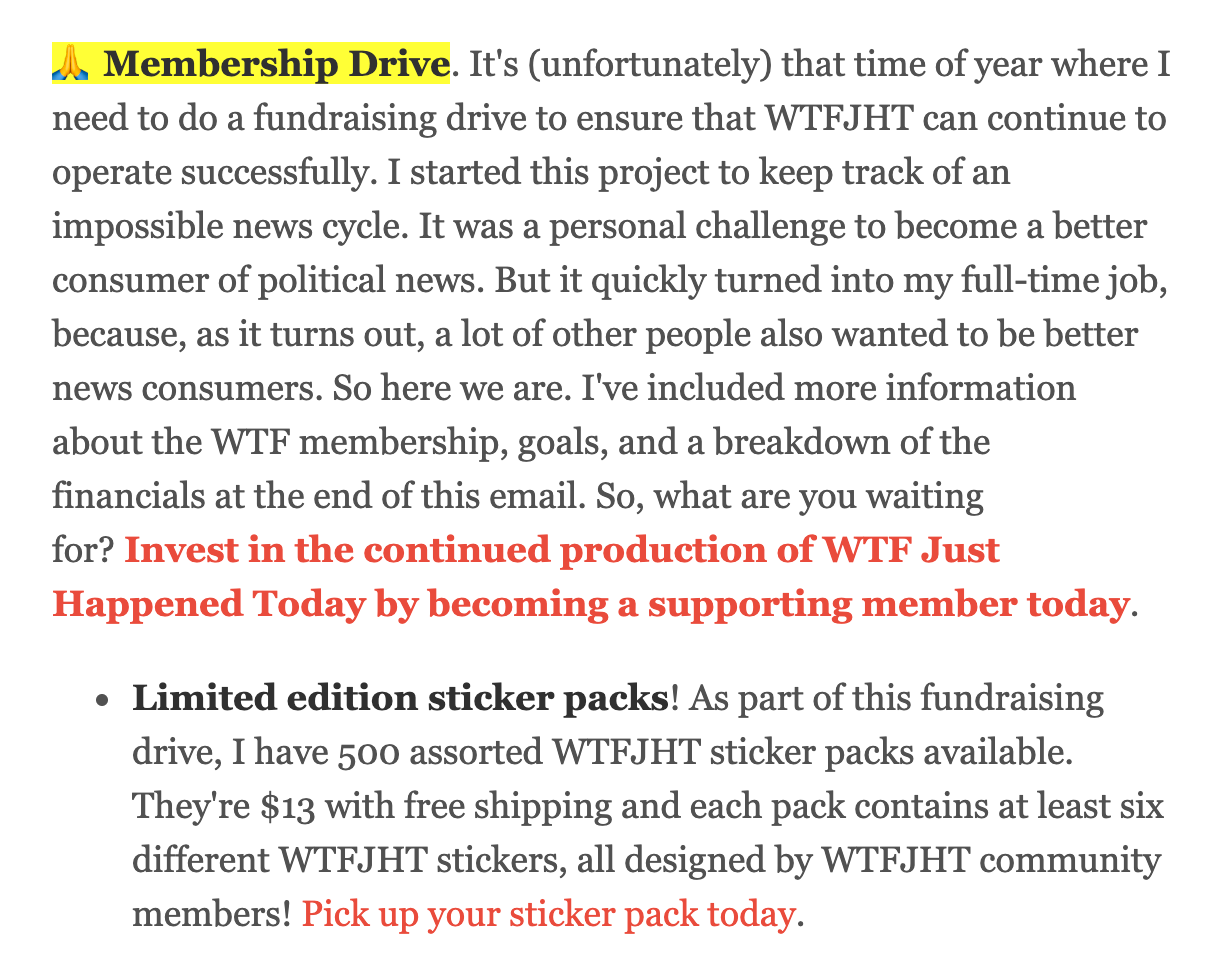
Kiser does not like doing fundraising drives (he feels uncomfortable asking for money). But at the end of the day, this is his full-time job and he knows it needs to be done. So in July 2019, Kiser launched another membership drive with a goal of signing up 200 people to become members. Here’s what he said in the body of an email to readers: 

WTFJHT’s email newsletter appeal (Courtesy of WTFJHT)

The results 

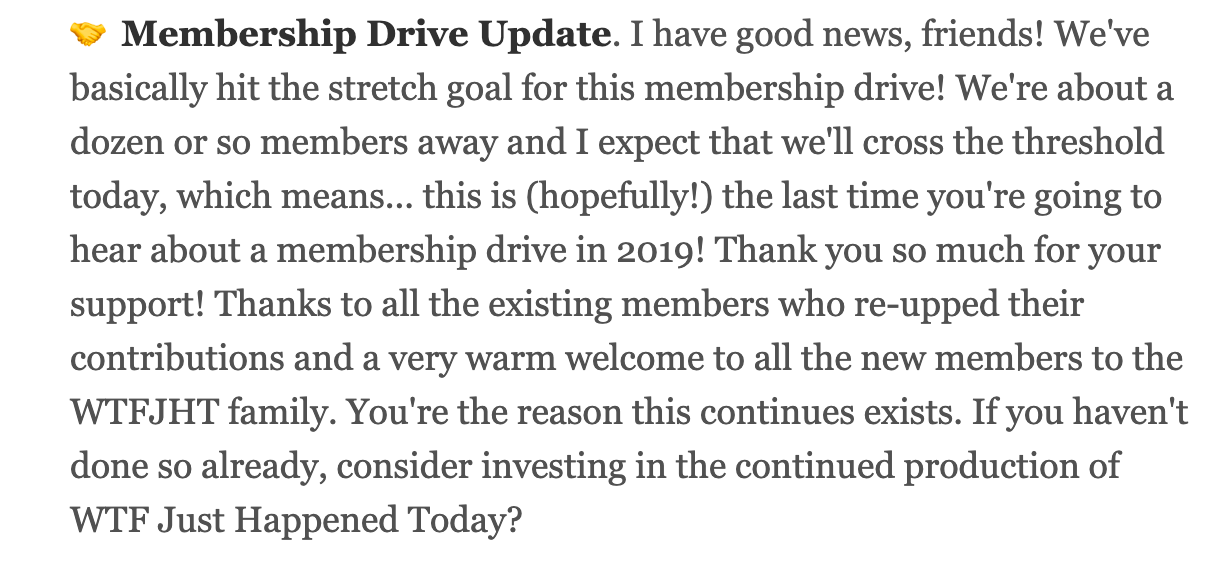
Three days later, after sending only two reminder email to his list, Kiser’s membership drive was about a dozen people away from his goal of 200 new members. 

See below for the update he sent over his email list open to the public: 

WTFJHT’s email newsletter update on the membership drive (Courtesy of WTFJHT)

The membership drive brought Kiser back to the financial threshold that enables him to continue publishing without sustainability concerns. 

Over the years and after a few membership drives, Kiser has been able to develop a more sophisticated understanding of incoming revenue from his membership base. This clearer method of projecting revenue took time — after years of collecting data and observing member behavior.

Kiser identified the below three metrics as crucial for developing stronger revenue projections:

  1. Member conversion rate: ~1-2% (a rough percentage of WTF’s audiences — newsletter and website combined — that becomes a member) 
  2. Average monthly contribution per member: $6.17 
  3. Annual Churn Rate: 5.8%

These three numbers help Kiser determine whether he’s on track and what he can afford each month.  Here’s how he explains it: “I’ve outlined my costs and what I want to be earning on the blog. As long as the budget balances, that’s all I care about – It’s how I know I’m creating sufficient value.” 

What they learned

Always set a goal (with a reason behind it) in your fundraising drives, and communicate this to your readers and members. In the past, Kiser made membership campaigns a week long, with no specific goal. At the end, he felt like his audiences were exhausted (and he was exhausted, too, from running his own membership drive over a week where he was still providing coverage each day). Now he always offers an explanation to his readers about why he’s doing a drive (like in the above case, because WTFJHT lost some members), and he sets a clear target. Once Kiser hits the goal, he ends the drive, and starts focusing on how he can retain his new members. 

As a one-person newsroom, don’t get overwhelmed by metrics. Kiser isn’t hyper focused on all of the audience data at his disposal. As he explains: “it’s more important to focus on the basic accounting of income and expenses than any tool or app.” Kiser looks at newsletter and membership conversion rates, average contributions per member, and annual churn rate as his major pieces of “directional evidence” to determine, essentially, is this working or not? At the end of the day, it’s really about making sure revenue exceeds expenses. As long as he can predict when he’s heading for the red and can correct course with member drives, he’s all set. 

Here’s some budgeting advice for other one-person newsrooms: Kiser prefers to use the self-employed version Quickbooks to track his expenses. He likes how Quickbooks has an app and website, connects to his business credit card and bank information, and allows him to easily categorize and create “rules” for expenses that come in. Apart from the DIY version of budgeting, Kiser also uses a CPA once a year to help with his taxes. As a “disregarded entity” (a sole creator with an LLC), Kiser’s unique tax status means he prefers professional help every March to make sure he files taxes correctly. 

Key takeaways and cautionary notes 

Be honest and upfront with your audiences. It helps to share your financial situation with your readers and members, even if it borders on TMI. Kiser finds that being radically honest with his books also helps him alleviate some of his hesitations around asking for money from his readers. As he puts it, “you can see, nobody’s getting rich here!” Being transparent is also one way to build trust when asking people to optionally contribute to your work.

Know when it’s time to pack up. Kiser doesn’t know how long this model will last, and he’s prepared to be able to make a call based on how he sees his member program fluctuate in the months ahead. He’s going to keep tracking the key metrics he uses to forecast incoming revenue and whether or not he needs to ask more folks for financial support, and he knows that he doesn’t know his ceiling. As he puts it:  “I’ve long had a compact with the audience that I’ll keep doing this as long as they keep supporting me. It keeps everyone honest and there will be no doubt come a time when WTFJHT ceases to be relevant, and it’s time to pack it up.” 

Other resources 

Newsroom overview

Who They Are
A digital media and consumer analytics company that inspires black women to realize how they can change their world through every click they make and every conversation they have
Location
London, U.K.
Founded
2014
Membership program launched
2017
Number of members
About 1,000
Percentage of revenue from membership
60 percent

Black Ballad aims to be the leading digital and physical space for creating economic empowerment for Black British women. In pursuit of that, they publish stories about Black women’s experiences, host events, support a vibrant member-only Slack community, and survey their audience members formally and informally. Their relationship with their readers and members is strong.

All of this has helped Black Ballad position itself as an organization that reaches, serves, and knows the 25 to 45-year-old British Black professional woman better than almost anyone else. They had a hunch that knowing this community would not just help them grow their membership program – it would help them unlock other revenue opportunities, too. 

In 2020, they tested that hypothesis by packaging their insights and journalism into an editorial campaign about Black motherhood. They used informal feedback from their Slack group to design a survey on the topic, distributed that survey to more than 2,000 women, and used the results to guide editorial coverage, add new knowledge to the conversation around Black motherhood, and secure a paid partnership to bring the conversation to mainstream media.

Why this is important

When people talk about membership revenue, they stop their calculations at the revenue from membership fees. But if you have a strong feedback loop with your members, that relationship can be the genesis of other mission-aligned revenue opportunities.

“Learning about what audiences care about and what they find important are more important data points than just surface-level statistics that capture general population behaviour,” co-founder and publisher Bola Awoniyi says. “If you’ve done a good job defining who your publication is for… then you can craft a business that’s based less on your scale and more on your understanding.”

But gaining the level of member engagement you need for that work requires mutual trust. A core part of Black Ballad’s mission is to create a space online where Black women can feel safe and thrive. By continually fulfilling that mission, they are making deposits on the trust that they draw on every time they ask their members to take time and energy to share personal insights. 

While few organizations have an audience as specifically defined as Black Ballad, these same principles can be applied to specific audience segments for organizations with larger audiences.

What they did

Black Ballad knew motherhood was an important topic for their members because it was consistently one of the top three topics members expressed interest in in the member onboarding survey. But the catalyst for the editorial campaign was new, critical statistics on Black women’s material experiences and Serena Williams’ and Beyoncé’s decisions to share their stories, both of which launched the topic into the mainstream. 

Black Ballad already had a strong sense of how their members felt about the topic. In May 2018 they created a #motherhood channel in their members-only Slack group. A year and a half later, they used those informal insights to begin designing an editorial campaign around Black motherhood, which they launched in January 2020 with a letter from editor-in-chief Tobi Oredein. (Disclosure: Membership Puzzle Project supported this editorial campaign with a grant from its Membership in News Fund.)

They began that project with a 100+ question survey, which asked questions such as:

  • For biological mothers, how prepared did you feel for your most recent child’s arrival?
  • For biological mothers, in what ways did you look into your own and your partner’s fertility prior to pregnancy? 
  • How long were you trying to conceive your first child?
  • For biological mothers, during your current pregnancy, how would you rate the care you received from the following NHS [National Health Service] healthcare professionals?
  • For foster parents, how long did the process take in being assessed for adoption/fostering from the start of the process, to child placement?
  • How different has the reality of motherhood been from your expectation?
  • Overall, how would you rate the support postpartum you have received?
  • For stepmothers, how involved would you say you are in decisions related to your stepchildren’s upbringing?
  • In what ways do you anticipate becoming a mother impacting your career, or in what ways did becoming a mother impact your career?
  • To what extent does/did money feature as a factor when thinking about having a family and how big your family should be?

They used facts about the Black motherhood experience as hooks to help the survey spread on social media, beyond their existing audience. 

That survey had a 60 percent completion rate and 2,600 respondents, with 40 percent of responses coming from outside London, where Black Ballad is just beginning to grow its membership. 

For the next several months they published on the topic continuously, using the survey data to add immediacy and depth to stories on topics like infertility. They continued to drive conversation and gather additional insights for months after by resurfacing data points and quotes via atomic social media posts

The results

Amid the Black Lives Matter protests of summer 2020, Black Ballad secured a partnership with HuffPost UK to talk about Black motherhood. For a week in August they took over HuffPost’s lifestyle section, parts of their homepage, their politics podcast, and several other owned assets. HuffPost is also paying the Black Ballad freelancers commissioned to do stories for HuffPost. They also secured a deal with the podcast company Acast based on the motherhood survey results and editorial work that will be coming out in fall 2020.

Black Ballad also fielded inquiries from a university that wanted to license access to the Black motherhood survey data for use in their sociology program and talked to several brands about partnerships. Although the pandemic disrupted both, Black Ballad sees them as indications of future opportunities, which were picking back up at the time of publication. 

Awoniyi now thinks of the Black motherhood project as a case study they can use to pitch future projects. He sees opportunities to monetize via sponsorships and grant underwriting, paid media partnerships, membership drives, and partnerships with academia and other institutions who find this type of data useful. They will use the steady stream of feedback from their onboarding survey and the Slack group to identify future high-interest topics worthy of this level of coverage. 

Each “package” is likely to have the following elements:

  • A detailed kick-off survey to gather quantitative and qualitative insights from Black women
  • Editorial commissions based on the survey results (sometimes a specific result was the genesis of a story, but more often the responses pointed to something interesting in the data for Black Ballad to explore more broadly, Awoniyi says)
  • Events 
  • Media partnerships and takeovers 
  • The packaging of data for other organizations who can use it in their work

Informed by their experience with the Black motherhood project, in May 2020 Black Ballad launched the Great Black British Women’s survey, a 100-question survey aiming to find out what issues most influence Black women’s lives. “We don’t want to repeat the mistakes of mainstream media and have one overly dominant voice, but claim to represent an entire demographic of people,” they wrote. 

Awoniyi anticipates that revenue opportunities connected to audience insights will “make up the lion’s share of Black Ballad’s revenue” in a couple years. “It’s much easier to rely on a £35,000-a-year deal from a university to license the data than however many thousand users it would take to replicate that in membership fees,” he says.

That doesn’t mean the members are any less central to their mission. Although other revenue streams remove some of the financial pressure to relentlessly grow the membership program, Black Ballad still sees member growth as a key indicator that they’re continuing to create editorial content and experiences worth paying for, and they know they need to continue serving their existing members well for this model to work.

Awoniyi foresees Black Ballad collecting a wide range of data points via surveys, from how much Black women spend on a certain item a month to how Black women in different parts of Britain feel about hiring nannies. Their goal is to build a database that individuals and companies can subscribe to in order to access survey response data stripped of any personal information – particularly appealing amid the move to first-party data.

What they learned

You need to know more about your members than their newsletter open rates.  Black Ballad has a multi-layered picture of who a Black Ballad member is – and that makes it much easier to design high-interest, high-impact editorial campaigns. She is:

  • A Black woman, typically 25 to 45 years old
  • A “socializing young renter” or mother with a young family 
  • Likely part of an educated family (85 percent of their paying audience has a university degree, 45 percent have a master’s degree, and 10 percent have above a master’s degree) 
  • Online a lot, especially on her smartphone
  • Highly social, likely active on Black Twitter
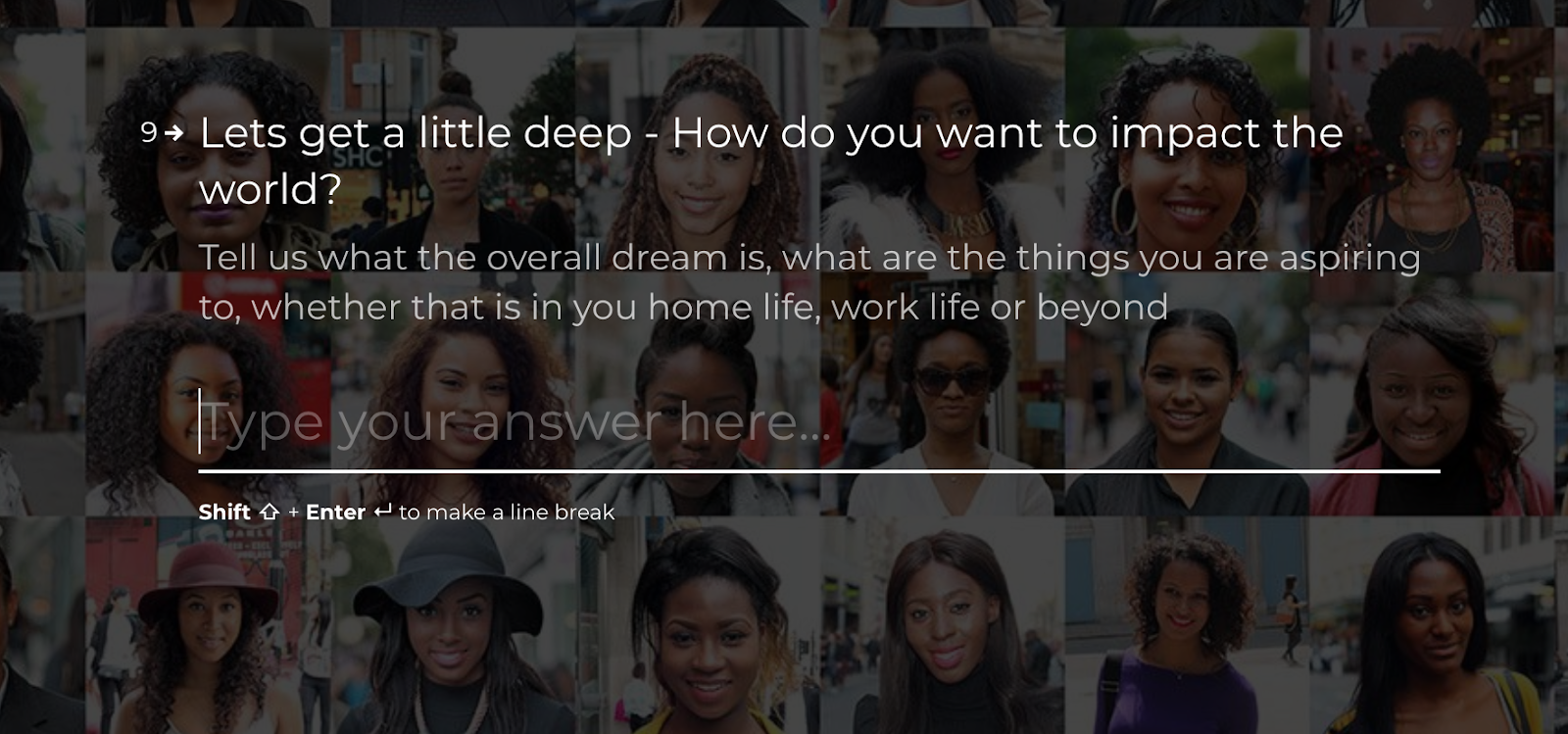
One of the questions asked in Black Ballad’s onboarding survey (Courtesy of Black Ballad)

“We call her professionally ambitious, culturally curious and socially conscious. … She wants to experience the fullness of life and figure out the best way to avoid the pitfalls that systemic racism and systemic sexism have laid before her. Black Ballad’s job is to help her figure out how to live her best life and how to maximize her life with every click she makes and conversation she has,” Awoniyi says. “She is in pursuit of how she can become her best self.”

Conversations are data too. The Slack group began as a safe place for Black women to gather online and build community, and that remains its primary goal. But, Awoniyi says, it has also evolved into “a pipeline of data for Black women who want to talk about issues most important to them.” Although anecdotal, when systematically collected, that data can be used to shape surveys, events, and editorial campaigns with stronger traction.

Monetizing these insights requires deep trust. Awoniyi knows that these editorial campaigns are only possible because they have their members’ trust. In their Black motherhood survey, they asked deeply personal questions about tough topics such as fertility and miscarriages. If Black Ballad takes steps toward becoming a true consumer insights platform, they’ll have to be explicit with their users about how Black Ballad uses their data.

Key takeaways and cautionary tales

It’s all about knowing your community. “The superpower of digital businesses is that they have the power to really understand their audience. More than anyone else, media businesses do very well when they focus on the community they serve and the topics that trickle down from it,” Awoniyi says. “I would definitely encourage other media brands to go back to first principles of ‘What does this audience need to fulfill whatever objectives they have and what do the people who want to reach this audience need to fill the objectives they have? If you’re able to do that, a bunch of revenue opportunities that are specific to the people you’re experts in should come your way.”

And having their trust. The other thing Awoniyi mentions as critical to the success of this approach is trust. Black Ballad is asking women to share their lived experiences with them (albeit in an aggregated, anonymized way) so that they can package that information and monetize it. “Because we built our brand on putting Black women first, trust is implicit. Black Ballad isn’t going to violate any trust that the audience has in them. We want to take a more robust approach in how we sign off usage of that data as we figure out how to use it commercially. But it’s not just that people pay for membership and trust us. In order to make it successful, trust is not just necessary, it’s table stakes.”

Make your onboarding survey work for you. Many of Black Ballad’s ideas originate with their onboarding survey, which includes the question “What three topics are you most interested in?” That survey has a 55 percent completion rate, with a mini incentive to encourage participation: you have to fill it out in order to get your coveted Black Ballad member pin. They use the onboarding survey data to inform everything from what channels to offer in their member-only Slack to what they should focus on in future editorial campaigns. And because its distribution is automated, it’s a form of always-on audience research.

Other resources

Newsroom overview

Who They Are
A Danish member-driven newsroom that seeks to add complexity and curiosity to the news
Location
Copenhagen, Denmark
Founded
2016
Membership program launched
2016
Number of members
17,000+
Percentage of revenue from membership
83 percent

Within a month of Denmark’s coronavirus lockdown beginning,  Zetland could see that this was going to be a tough moment for many of their members – Zetland was hearing from members about losing jobs, having their hours cut, or being unable to work. Zetland wanted to find a way to keep these members through the tough times. At the same time, they knew other members were in more fortunate positions and might want to help during this time of crisis. 

So Zetland rolled out a series of pricing adjustments and doubled down on their retention efforts. They offered price flexibility to those who asked to cancel their membership, asked those who could afford to pay more to do so, and experimented with a new feature to make membership more valuable. 

Why this is important

It is important to invest in retaining your members, especially during a recession. Recruiting and signing up a new member is a costly endeavor, likely more costly than giving your existing members some flexibility on payment for a little while. Focus on retaining the people who already know and like what you do. 

But offering discounts or price breaks for membership is a delicate balance. If you discount it too much or message the discount poorly, you risk devaluing membership. Zetland has been careful to send the message that it’s not becoming a “pay what you want” company – instead, they want to be known as a company with a set value that is empathetic and willing to be flexible with their members. 

While the coronavirus pandemic is (hopefully) an extreme example of sudden economic hardship, Zetland’s approach to keeping its members is instructive for any newsroom in a community facing economic hardship, whether caused by a virus, a natural disaster, or a market crisis.

What they did

Zetland knew that most members were facing one of two scenarios during the coronavirus pandemic: either Zetland was suddenly a luxury good for those hit hard by the recession, or they were financially stable and wanted to do their part to ensure Zetland survived. 

So, starting April 15, Zetland added a new feature to their unsubscribe page: a note next to the unsubscribe button that says, essentially, “If you’ve been negatively impacted by all of this, don’t leave us for good. Tell us what your situation is, and we’ll reduce the price of membership for you.”

The page invited those who were about to unsubscribe to pay what they could instead. They informed members of the change via email. In the same email, they wrote, “If you find yourself in the lucky situation of not being hit by this pandemic, please consider paying more.”  

As the coronavirus pandemic dragged on, they doubled down on their efforts to retain the members they had.

During Zetland’s 2019 ambassador campaign and during their February roadshow (a series of stops the newsroom made to five cities in Denmark to meet their members there), they heard that members wanted a better way to express the value of Zetland and what the newsroom meant to them personally. Above all, they heard that members wanted to communicate this value with Zetland’s articles. 

Previously, Zetland (which has a paywall) had given ambassadors – or anyone who has recruited a new Zetland member – the opportunity to send their contacts a set of Zetland articles as a way to entice them to join. Zetland decided to try making this package of articles a perk for any new member, and moved it from being a sales pitch to a key part of the new-member onboarding welcome package. They launched this new feature on Aug. 24, 2020. 

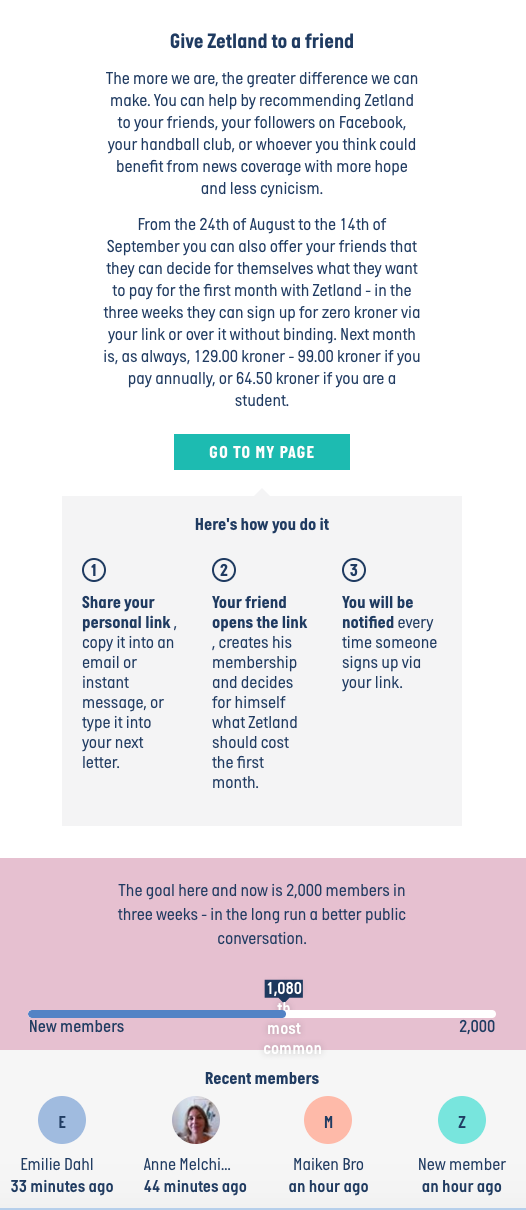
Courtesy of Zetland, August 2020

Here’s how it works: Current members and ambassadors create a “package” containing their three favorite Zetland articles (see image to the left for what this web page looks like). Then, current members are encouraged to share their personal URL link with their friends and family. When their friend or family members joins Zetland, they are then immediately presented with a personalized onboarding package from their referring contact that includes the three “must read” articles. (Note: Zetland members are still able to share individual Zetland articles with friends apart from this “onboarding package,” but the team sees this process as an intentional way to greet new members.)

The Zetland team let members choose the package of stories, rather than making suggestions, because they knew the pull of a friend recommending an article would be stronger than the pull of anything recommended by an algorithm. 

The results

As of September, 283 members had taken Zetland up on the pay-what-you-want offer on their cancellation page. These members are now, on average, paying 45DKK, or about $7 a month. This is a little more than a third of the average general price of 113DKK, or about $18 per month. 

On the other hand, 233 members decided to donate an average of 65DKK extra a month, or about $10 a month. What this means is that those 233 members are largely offsetting the cost to Zetland of those 283 members who asked to pay less for their membership.

Zetland also began studying its analytics for broader retention insights around this time. They noticed that when a member stops reading Zetland at least once a week, that’s a strong indicator that they’re likely to cancel their membership. A key part of retention is building habits, so the flip side of that is also true: when someone’s habit begins to wane, you’re more likely to lose them.  

The new onboarding package had just been launched at the time of publication, so MPP does not have results on that yet. Zetland plans on comparing the difference in retention in the first few weeks after someone becomes a member since implementing this new feature, as well as long-term retention a year or two into membership. 

What they learned

Maintain empathy with your members beyond the initial crisis. Zetland only removed the new language next to their unsubscribe button on Aug. 18. They decided to keep it up beyond the spring to give this explicit option to folks who might be hit with financial hardship throughout the summer. Even though they’ve now removed this specific language, Zetland still allows members to pause their membership payments from 7 day and up to 90 day increments. This allows Zetland to stick with the price they’ve defined for their membership program, while letting people take breaks as they need it. 

Leverage your most loyal readers and members for ideas on how to improve your membership program. The roadshow the Zetland team went on in February to speak to readers and members across five cities in Denmark allowed the team to talk to what CEO Tav Klitgaard calls the “hot onion” – the small and mighty segment of Zetland members who are the newsroom’s most loyal fans

This segment of members is largely composed of Zetland’s ambassadors, who have their own email list and Facebook group, and have opted into additional communication from the Zetland team. Conversations with the ~200 or so folks in the “hot onion” group during the roadshow planted the idea for the story package feature. After the roadshow, Zetland sent a survey to all of their members (not just the super-fans) to double check that this feature was something other members wanted. They ended up receiving 1,600 survey responses that validated what they heard in-person. 

Key takeaways and cautionary notes 

Keep your value proposition clear when you make changes to your payment structures and discounts. Zetland makes it clear with their members that they are a newsroom that expects members to pay a set price per month (129DKK, or about $20 USD per month.) Zetland does not want to be or want to be known as a “pay what you want” company – instead, they want to be known as a company with a set value that is empathetic and willing to be flexible with their members. This distinction is key, and Zetland is careful to emphasize this point in their marketing with members and in the language on sign-up forms on their site.

Other resources 

Newsroom overview

Who They Are
A Danish member-driven newsroom that seeks to add complexity and curiosity to the news
Location
Copenhagen, Denmark
Founded
2016
Launched membership
2016
Number of members
17,000+
Percentage of revenue from membership
83 percent

In summer 2019, about three years after Zetland launched, the founders faced a hard truth. Despite many successes, they still weren’t profitable, and they were running out of time. Their monthly expenses totaled 1,650,000 krone (about $178,000), but monthly revenue only totaled 1,300,000 (about $140,000). CEO and co-founder Jakob Moll ran the numbers, and found that if they could grow their membership from 10,500 individuals to 14,000, they would break even.

With a clear goal in mind, they knew they needed to grow their membership, and quickly. Rather than turn to a typical marketing or acquisition campaign, they took a gamble: if they opened up about their financial situation and appealed to members’ passion for Zetland, could they enlist those members to help change their financial trajectory?

What followed was one of the most ambitious member-ambassador campaigns Membership Puzzle Project has seen. They surpassed their goal in less than a month, and at the end of 2019 they reached a major milestone: financial sustainability. 

Why this is important

Marketing is an important component of your membership growth strategy, but many newsrooms focus on that and completely forget about one of the most powerful tools they have: their most loyal members. The Membership Puzzle Project sees membership as, among many things, a way to identify your strongest supporters and incorporate them in your quest for sustainability. 

Few initiatives embody that more clearly than Zetland’s “members getting members” campaign.

The campaign wasn’t flashy. It didn’t include celebrities or any over-the-top swag. It succeeded because Zetland found the intersection point between their audience members’ passion for Zetland and their newsroom’s sustainability needs – and they were willing to offer complete transparency in exchange for members’ help. Understanding what motivates your audience members to participate and figuring out how that intersects with your needs is key.  

What they did

In June 2019, co-founder and then CEO of Zetland Jakob Moll published a piece headlined: “Here are the key figures about Zetland’s business that are usually kept secret in a business like ours.” The article laid bare Zetland’s financial books. 

Moll was blunt: “Right now, our expenses are greater than our income – in other words, the amount in our bank account is shrinking every month. If you spread out the snapshot over a whole year, we have an income of 1,300,000 a month and expenses of 1,650,000. If we had 14,000 paying members instead of 10,500, our expenses and income would balance.” 

Moll’s financial tell-all article also introduced members to a proposed solution: become an ambassador for Zetland and recruit new members. In the ambassador campaign, newly recruited members got to pay whatever they wanted for the first month of access, but after that, they would have to pay the standard monthly membership fee of ~$14 a month. Here’s what this process looked like in practice:

They recruited “ambassadors” from their current member base. Ambassador recruitment officially started with Moll’s financial-tell-all article, which included a sign-up form for ambassadors that first verified the respondent was already a Zetland member. The sign-up form was also the process for onboarding ambassadors and included questions about how the ambassador preferred to recruit their new members. Over the next two weeks, more than 1,000 people across Denmark signed up to become ambassadors.  

They equipped their new ambassadors for both digital and print recruitment campaigns. When a member became an ambassador, Zetland gave them a unique signup page URL that included their name. The URL brought potential new members to the pay-what-you-want sign-up form. Zetland also gave ambassadors the option of postcards or posters to spread the word offline. They shipped out more than 20,000 postcards and 2,000 posters with ambassadors’ personal codes for the ambassadors to share when the campaign launched. 

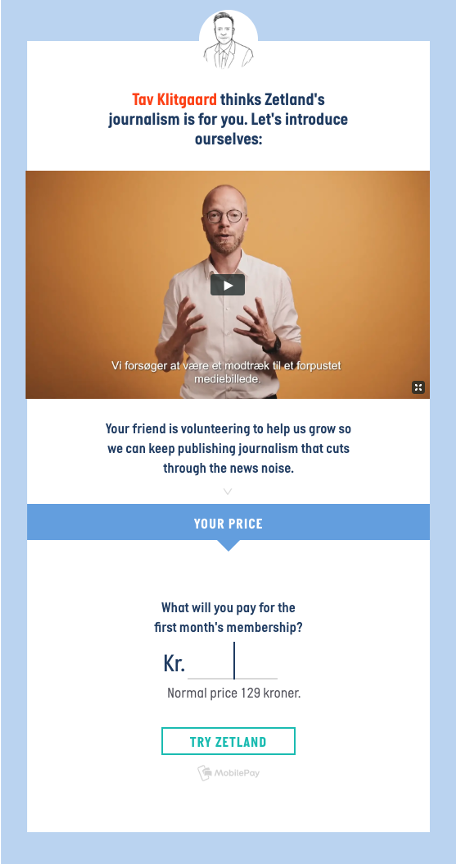
They officially launched their ambassador campaign on Aug. 6, 2019. The ambassadors started recruiting new members by sharing a recruitment form with a video of Moll introducing himself and Zetland’s mission. Then, the reader was shown the dominant call-to-action, which was the pay-what-you want box. 

Courtesy of Zetland

When a new member signed up, Zetland sent them a long, personal welcome email from Lea Korsgaard, the editor-in-chief. They frequently reminded their readers, members and ambassadors that “this is your campaign, it’s not ours.”

Membership Puzzle Project shared additional details about the execution in its 2019 case study of the campaign.

The results

Zetland’s ambassador campaign launched on Aug. 6 and formally ended on Sept. 6. Their goal was to add 1,400 members to their then-10,500 members. They reached that goal in a week. In September, they passed 2,500 new members (totaling 13,000 members). By the end of the campaign, they surpassed 14,000 members. 

That 14,000 number is significant because at 14,000 members, their newsroom broke even and started making a small profit. About six months after the campaign officially ended, Moll reported to Membership Puzzle that they are “moving toward 15,000 members.” So far 346 of those original ambassadors have signed up to be ambassadors year-round. 

The pay-what-you-want model for the first month was also a success. New Zetland members didn’t go for the lowest possible payment. (On average, new Zetland members decided to pay a little bit less than the equivalent of $9, when the sticker price for the first month of membership is equivalent to $6.50.)

In addition to volunteering to help recruit new members, more than 500 Zetland members also volunteered to help with member-driven editorial projects in the coming months. 

What they learned

Look to recruit people who are willing to pay some amount for membership. Zetland ran its first ambassador campaign in 2018. It brought in 700 new members, but many of those members didn’t stick. Only half of them even logged on to Zetland after the campaign ended. Moll believes that giving free access sent the wrong message to their audiences. In 2019, Zetland focused on recruiting members who understood the value of high-quality journalism — the folks who were willing to pay for it — and it worked. The members recruited during their 2019 campaign have a retention rate that mirrors that of Zetland’s overall membership.

Be honest about your financial situation and what you need from your members. Zetland found their ambassadors eager to jump in and help the newsroom reach financial sustainability. The radically honest articles published prior to the ambassador campaign’s launch (including how many more members, exactly, they needed to survive) helped mobilize their current members into action.

Set up your ambassadors for success, and say thank you often. The Zetland team worked hard to make their ambassadors feel special, empowering them to recruit new members either digitally with their personalized URLs or manually with postcards. Ambassadors also received small gifts like stickers and packets of plant seeds. The Zetland team was sure to say thank you often, and to keep their ambassadors updated on the newsroom’s progress and success along the way.

Key takeaways and cautionary notes

Find ways to harness members’ passion for your organization. Ambassadorship taps into members’ passion for your work – one of the six key motivations MPP heard when analyzing responses from hundreds of supporters of news organizations about why they gave their support.  Members motivated by the chance to show some love for your mission are proud of their affinity with your organization and want people to know about it. 

Although only a small percentage of your members will likely respond to your call for ambassadors (the 90/10/1 rule is that 90 percent of members will just consume the product, 10 percent will interact with you, and 1 percent of that 10 percent will become core contributors), that small percentage can have a transformative impact.

Other resources

Newsroom overview

Who They Are
A national, born-digital publication focused on policy analysis and investigative journalism that has branched out into lifestyle, sports, and business coverage.
Location
South Africa
Founded
2009
Launched membership
2018
Monthly unique visitors
3,500,000
Number of members
13,693
Percentage of revenue from membership
25 percent

When the Daily Maverick launched its membership program, Maverick Insider, they had two goals: make membership as inclusive as possible, and make it easy for those who could provide financial support to do so. So they eschewed membership tiers and implemented a “pay-what-you-can” model, with one key benefit that incentivized those who could afford to contribute more to do so.

Why this is important

The design of your membership program sends clear signals about who it is for. Tiers can help nudge members toward certain financial levels and add predictability to your financial modeling, but they can also bring a level of exclusivity that is discordant with a commitment to equity and inclusion.

The Daily Maverick sought to address this tension by using a pay-what-you-can model for their membership program, Maverick Insiders. Well-designed defaults and benefits nudge those who can afford to pay more to do so, helping the Daily Maverick continue to meet its membership revenue targets.

What they did

When the Daily Maverick launched membership in August 2018, they launched the pay-what-you-can scheme with a slider tool on their membership landing page. Although members could select any amount above R75 (about $4.50), they sought to influence members’ selection by setting the default to R150 (about $10). That was the most common selection among early members, followed by the minimum of R75, or less than $5. (That was the lowest the payment gateway company would process recurring billing contributions.)

The Daily Maverick’s membership landing page includes a slider (Courtesy of Daily Maverick)

This decision was partially informed by the donations drive they ran a few months earlier. The average recurring contribution during that campaign was 100 rand (about $8). The Daily Maverick hypothesized that R150 (about $10) was a reasonable ask once the benefits and community of membership were offered in exchange.

In addition to providing an easier payment process, the Daily Maverick also believes that the pay-what-you-can model helps put their membership in a different category than subscriptions, addressing the issue of subscription fatigue. Tiers are less common among charitable causes, and the Daily Maverick sought to frame joining as charitable support for a free press and equal access to information.

“It taps into a different part of the brain – and budget,” CEO Styli Charalambous writes. “Research shows that the average American household has $30 available for subscriptions and within that space, enough for just one news subscription. And that’s wealthy American households. But people can and do support multiple good causes that resonate with them. We wanted to convey our cause that was worthy of support alongside the Society for the Protection of Animals, National Sea Rescue Institute, or educational development programmes.”

A few months later, the Daily Maverick had a chance meeting with the head of business development for Uber in Africa. Charalambous pitched Uber on the idea of using Uber vouchers to encourage the acquisition and retention of members. They settled on R100 in Uber credit every month to every member contributing R150 or more every month. 

It wasn’t a no-brainer decision – the Daily Maverick knew that its members were not interested in being a part of a corporate reward program, and didn’t want Maverick Insiders to become that. All of their other benefits were connected to the Daily Maverick’s journalism. But events were a critical part of their membership strategy, and this seemed like a valuable way to make it easier for members to get to events. 

For Uber, it was a chance to achieve greater brand awareness and ridership as they entered the South African market.

The results

When the Daily Maverick first launched the pay-what-you-can model, about 50 percent of their members chose the pre-selected R150 option – a percentage the staff was happy with.

The addition of the Uber benefit, however, was a game changer. It worked, almost instantly. According to CEO Styli Charalambous, the number of people contributing R150 or more a month jumped almost immediately to 90 percent with the addition of the voucher. Daily signups also increased by about 30 percent, with monthly sign-ups consistently topping 300 people. 

Although it wasn’t a no-brainer decision for the Daily Maverick to offer this benefit, it was a no-brainer decision for most members to opt into it. If they were likely to use Uber at least once a month, they would actually save money by increasing their contribution to R150

What they learned

People won’t give the bare minimum, even if they can. One of the assumptions that goes into the design of membership tiers is that people will give the minimum amount they have to give to get member benefits, so there needs to be a floor. The fact that at least 50 percent of the Daily Maverick’s early members (pre-Uber benefit) opted for the suggested R150, rather than the minimum R75, disproved that assumption, at least for the Daily Maverick.

Key takeaways and cautionary notes

Be smart about your nudges. A well-designed, well-targeted discount or reward can help nudge members toward the contribution level that you need to be sustainable, but choose these benefits carefully.

“We have been careful not to be pulled into the discount offer space,” Charalambous writes. “We made this single exception and it worked, but we have not offered any other membership benefits that don’t relate to the [Daily Maverick] experience in some way. We are not a corporate rewards program, we are a cause, and the membership programme should reflect that.”

Other resources 

Disclosure: Membership Puzzle Project has provided support to the Daily Maverick’s membership program through the Membership in News Fund.

Making the business case for membership

This section addresses the topic of membership and money. What revenue can you expect from a membership program? What costs should you plan for before you decide to launch a membership program?

First, a reminder. Membership is more than just a piece of a revenue pie. Membership is a relationship between a newsroom and its supporters that treats audience members as core participants and stakeholders. This relationship is supported by memberful routines, which MPP has found are a critical component of a membership strategy. 

Members can also be a source of revenue support, as they are in most member-driven newsrooms MPP has studied. In order for that revenue strategy to work, you need to understand what scale of investment (and ongoing cost) is required and what scale of returns you can expect.

Here’s a second reminder: compared to subscriptions, membership in news is still a relatively new model and a relatively new revenue strategy. The Institute for Nonprofit News’ 2019 Index Report, which aggregates data from its 108 member newsrooms based in North America, found that only a third of its newsrooms reported having a membership program in 2018. About two-thirds of those membership programs are quite young: three years old or younger and have fewer than 1,000 members. Membership is even more nascent in Latin America, Africa, and Asia.

Keep this in mind: the value proposition and business model for membership are different from the value proposition and business model for subscription. In a subscription model, audience members pay for access to a product or service. It is a transactional relationship in which access to the content is what is monetized. This model typically requires a paywall of some kind. 

An open question remains whether membership will follow charitable giving trends or subscription trends in terms of revenue growth across newsrooms. The industry does not yet have the data to definitively answer that question, although the research team sees a lot of reasons for hope and opportunity for membership revenue growth. One exciting trend MPP has identified in its work with newsrooms is that, unlike what we are seeing with subscriptions, the membership ceiling has not yet been reached. 

Some successful member-driven newsrooms are leaning into a strong distinction between membership and subscription in their value proposition and marketing. The Daily Maverick in South Africa implemented a “pay-what-you-can” model, partially to tilt supporters’ minds toward charitable causes when considering joining. CEO Styli Charalambous wrote: “Subscription fatigue is a thing, and publishers in South Africa have to compete with the New York Times for a slice of people’s subscription budget.… But people can and do support multiple good causes that resonate with them. We wanted to convey our cause that was worthy of support alongside the Society for the Protection of Animals, National Sea Rescue Institute, or educational development programmes.”

In this section, we focus on financial planning and forecasting for membership, which should help your newsroom decide whether or not to pursue membership, whether to stick with membership, or whether to invest more resources into membership to continue building it as a source of sustainability.

How should we calculate our universe of potential members?

If you are starting a membership program from scratch, often the first thing you want to figure out is the range of member revenue you can reasonably expect to generate. Is it $30,000? $300,0000? Modeling revenue requires estimating how many members you can expect, paying what level of membership. To begin, you need to estimate how many members you can reasonably expect to attract by calculating your total addressable market.

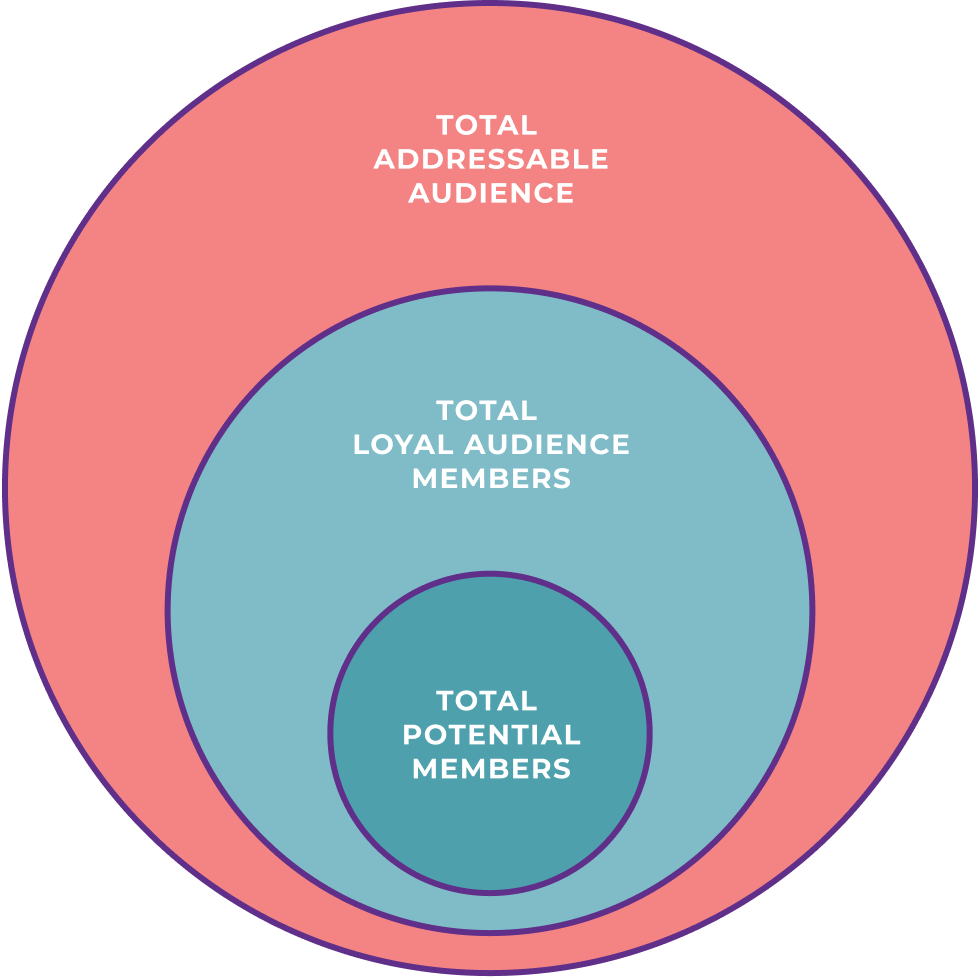
Calculate your total addressable audience.

Calculating your total addressable audience starts with understanding some basic demographics of the community you are seeking to serve: How many adults over the age of 18? How many households? What is the average income and employment level in your community? 

For example, if you are a newsroom serving a particular city, you can start a calculation of total addressable audience by pulling census or similar data on population size for 18+ year old people living in your city. If you serve a particular demographic group, age group, or neighborhood, you’ll want to narrow in on what percentage of the population they make up in the geographic area you’re covering.

If you are a newsroom that reports on a particular topic, this is a bit more complicated, but you can likely start by looking at industry data on how many people work in a field that your reporting might cover, or looking at membership numbers in professional associations in your field.

Illustration by Jessica Phan and Content provided by Corporate Finance Institute

Obviously not everyone in your total addressable audience will read your journalism. It’s likely only a small percentage will. According to the annual Digital News Report, 28 percent of readers worldwide prefer to get their news online. (In the U.S., that number is 37 percent) This rate will vary across communities, but you could use that preference rate to get a rough calculation of the universe of adults in your community whom you could hope to reach.

Combining estimated news consumption rates with some basic demographic data on your community will help you get to an addressable audience estimate. 

Let’s say you are a local news site in the U.S. serving a city of 200,000 and 80 percent are over the age of 18. So there are 160,000 adults in your city, and 37 percent of them, or 59,200 people, likely prefer to get their news online. That means your total addressable market is 59,200 people. (You could make a more conservative estimate by looking at the number of households rather than the number of adults.)

Your total addressable audience calculation is what is called in marketing terms the “top of the funnel” – the maximum number of people you can reasonably expect to reach. The point of marketing (and relationship-building) is to get those potential readers from the top of your funnel into successive stages of a deeper relationship with you, in this case into membership. 

How many members can we expect to get?

In order to estimate membership revenue, you need to make some informed guesses about how effective you can be at getting the attention of people in your community and then building a closer relationship with them. That means you’ll need to make some assumptions about what your audience funnel is going to look like. 

With your total addressable market calculation in hand from the previous section, there are a number of steps you can take next to model your audience conversion funnel and ultimately estimate revenue. One option is to model web users; another option is to model newsletter subscribers. 

Use your total addressable audience to estimate monthly unique users and site visits. If you are a startup newsroom with no audience yet, you can use your total addressable market calculation to estimate how many web users you can expect at the top of your funnel. (If you’re already publishing, you can just use your existing monthly uniques). To estimate web users at the top of your funnel, first decide how conservative you want to be in your estimates of how many potential digital news readers you can attract to read an article on your site. For example, you could estimate that 25 percent to 75 percent of the digital-news-reading adults in your community would actually find your site and read articles regularly. 

Let’s return to our earlier example from the previous section (in summary: you are a local news site serving a city of 200,000 and a total addressable market of 59,200 people). If 75 percent of those adults found you, that would give you an upper limit of 44,400 monthly unique users. 

If you assume that 50% of those readers who found you became regular readers of your site and visited you twice a week, that would give you (22,200 + (22,200*2*4)) ~ 200,000 monthly site visits. That gives you 200,000 chances per month to bring a user further down your conversion funnel. (Jump to “Developing membership metrics” for more on measuring repeat activity as indicators of loyalty and membership.)

Use monthly site visits to estimate newsletter subscribers. One of the most high-performing  pathways to membership, particularly for more traditional newsrooms, is via newsletter subscription. If you are a news site with a robust digital audience already, you can use your monthly site visits to estimate a goal for your newsletter subscribers, and from there calculate your membership potential. There are some early industry benchmarks in the U.S. for how many monthly site visits you can expect to convert to newsletter subscriptions. Among News Revenue Hub newsrooms, 8 percent of monthly website visits turn into newsletter subscriptions. If we go with 8 percent in this example: at an 8 percent newsletter subscription rate, with 200,000 monthly site visits, you could expect to convert (over time) up to 16,000 readers from your website to your newsletter list. 

Use newsletter subscribers to estimate your number of members. Getting a site visitor to become a newsletter subscriber is an important step toward gaining a member. But, of course, not all newsletter subscribers will become members. So, how can you model this step? 

Modeling the transition from newsletter subscriber to member involves making an assumption about newsletter conversion rates. The Facebook Local News Subscriptions Accelerator Program reported that publishers might expect to convert five to 10 percent of email subscribers to paying subscribers. For small and mid-sized newsrooms in the U.S., News Revenue Hub reports that among their clients, a good conversion rate to membership from newsletters is 7 percent. Suppose we go with a 7 percent conversion rate for this example: if you have an overall target of 16,000 on your newsletter list, you should expect to have, over time, 1,120 members. Strong editorial products and significant investment in memberful routines could lead to a higher conversion rate for your organization.

Calculating these audience and member estimates is not just useful for calculating revenue projections. They can be useful for setting goals for loyalty-building editorial products and your membership program. (Jump to “Adopting a product mindset” for more on setting goals.)

A caveat on how quickly you can expect to reach your member target. There is no magic formula for the timeframe in which you should expect to reach that member target. How quickly you meet (or exceed) your member target depends on a number of factors: how clearly you articulate and deliver your membership value proposition, how effectively you launch your membership program, how effectively you can market and grow your membership program, and how effective you are at retaining members. See those sections of the Handbook for more.

MPP does have some data to offer on newsrooms’ member yield in the first year of membership. According to data collected as a part of the Membership Puzzle Project’s Defining Membership Goals and Successes Surveys from 40 member-driven newsrooms around the world,  ~1,000 members is right around the median number of members most member-driven newsrooms reported having in their first year after launching a membership program. (Two things to note here: there were some outliers reporting several thousand members, usually from larger, more mature newsrooms, and we defined membership in the survey question as “individuals who contributed between $1 – $5,000 to your organization in the last 365 days”).

When we asked the same set of respondents how many members they have in the past 365 days (as of the date of taking the survey over this past summer 2020), our set of newsrooms reported a median of 2,668 members and an average of 10,223 members. Jump to “Developing membership metrics” for more information on the methods and results from MPP’s Defining Membership Goals and Successes Survey.

How should we set prices for our membership program and offerings?

The revenue you can expect to generate from membership will be heavily dependent on your pricing model and pricing tiers. You should consider your pricing model options and then, if possible, conduct audience research to test pricing tiers. Taking these two steps before you model revenue will help ensure your membership business model is robust.

After surveying dozens of newsrooms about their pricing strategy, MPP suggests one or a combination of the following strategies for determining your own.

  • Looking horizontally to other membership organizations that are geographically close or mission-aligned
  • Asking your audience members what other causes they support and how much
  • Studying the range of contributions to previous crowdfunding or donations campaigns
  • Launching with multiple options, or a pay-what-you-can option, and studying the patterns that emerge

Consider your pricing model options. There are many options to consider for pricing models. Some member-driven newsrooms, like Denverite, let all members choose exactly how much they would like to pay and whether they would like to pay that amount monthly, annually, or one-time. Most member-driven newsrooms have membership tiers that are priced at specific levels, whereas others like CALMatters in California define ranges and spell out member benefits within each broad range. MPP has also followed with great interest the Daily Maverick’s “pay-what-you-can” model, which is coupled with a suggested monthly amount. Look at the “individuals fund work” column of the Membership Puzzle Project database for a more complete list of pricing structures. 

It can also be helpful to look at publicly available benchmark data to get a sense of reasonable pricing, like the below table from INN’s 2019 Index report which shows an average member donation of $72 per year. Because MPP recommends encouraging your members to become monthly recurring members, you would divide $72 by 12 to end up with a minimum monthly reference price of $6. (Jump to “Retaining members” for more on smart payment defaults.)

Set your membership prices. Pricing discussions can be the most daunting part of designing a membership program, especially for smaller organizations who don’t have a business-side team. Much of the advice on pricing is incredibly complex and designed for larger, more corporate entities. 

Most pricing research language puts support for journalism in a transactional frame, putting your membership program in competition with one-way transactions like Netflix subscriptions. But pricing membership is actually about understanding both the value of your work to someone and how much they value ensuring other people can access it. 

This philanthropic giving impulse can be tricky to put a monetary value on. You may need to test out different prices until you find the intersection between your financial needs and your members’ ability to give. 

The decades-old Van Westendorp Price Sensitivity meter is the go-to method in the audience revenue space for assessing a price your audience members will find palatable. But for smaller organizations the Van Westendorp meter might be overly complex and could come across as too corporate. Asking audience members to complete it in a survey could undermine the sense of community that motivates many members. It is mentioned here because Membership Puzzle Project is often asked about pricing strategy in the subscription space, but MPP doesn’t necessarily suggest this for your newsroom.

Sebastian Esser, CEO of membership platform Steady, says that organizations tend to underprice dramatically. This was the case at Krautreporter in Germany, which he also founded. Krautreporter raised its prices in December 2019 for the first time, and said that they received no pushback or cancellations in response to the price increase.

El Diario in Spain took a fairly straightforward approach when they launched their membership program in 2012 – they looked across the media landscape and set their own membership price (€60 a year at launch) in between the more expensive subscription-based legacy publications and the less expensive digital journalism organizations. When they launched, their membership program quickly gained traction, with little pushback on the price. El Diario has almost 60,000 members today. In spring 2020, they raised their price for the first time, to €80 a year, but experienced no dropoff in membership as a result.

The Daily Maverick used a donations campaign to test several of its assumptions about membership, including what people would be willing to give if it was left open-ended and what would happen if they changed the default amount. They found that even when given the option of giving the bare minimum required – the cost of a credit card transaction, essentially – few people took that choice. 


How Daily Maverick designed a pay-what-you-can model

A well-targeted benefit nudges those who can afford to contribute more to do so, while keeping membership accessible for all.

The Dispatch, a conservative news startup in the U.S., launched in October 2019 with a lifetime membership option priced at $1,500. They used their annual membership price of $100 as the baseline, framing it as, essentially: “if you believe in fact-based reporting and analysis informed by a center-right perspective, join us as a Lifetime Founding Member to give our efforts a jump-start.” They had hoped they would get 300 lifetime members, but they had 450 in July 2020.